How Our Radio Code Generator Works for 2000 Honda Civic
Getting your radio code takes only 4 simple steps.
- Locate the radio's serial number - this is the only info required by our side.
Unlike when contacting the dealer, no VIN is needed. - Enter the serial number into our generator above.
Our system checks it against a database of supported radios and automatically retrieves the matching radio code. - In most cases, the code appears instantly on the screen after you pay and is also sent to your email , just in case.
If manual verification is required (rare situations), you'll be informed before checkout. - Once you receive it, just enter it into the radio to restore the functionality.
Inputting the Security Code
When you obtain the correct unlock code based on the serial number, you can restore default functionality by entering it into the unit.
The code entry process depends on the radio interface, but most 2000 Civic systems follow a similar structure using preset buttons, touch controls, or rotary knobs - depending on if it's a factory or an aftermarket unit.
You will typically see CODE displayed on screen.
The Correct Way to Enter It
To input the unlock code on the 2000 Honda Civic:
- Turn ignition to ON. The radio shows "CODE".
- Press preset buttons 1 through 5 to enter your 5-digit code:
- Press button 1 repeatedly until the first digit is correct
- Press button 2 for the 2nd digit, and so on
- Press and hold preset button 6 for about 3 seconds to confirm.
Lockout: After 3 incorrect attempts, the radio locks out. Leave the ignition ON for 60 minutes, then try again. Do not turn the key off or the timer restarts.
Entering the 5-Digit Code on the 2000 Civic
Once you have the correct 5-digit anti-theft code for your 2000 Civic radio, the entry process itself only takes a few seconds, but you have a strict attempt limit before the radio locks itself out, so verify the code before you start.
Limited Attempt Warning
You only get around 10 attempts. After roughly ten consecutive wrong codes, the factory Honda radio of this era enters a lockout state and the display shows Err or E. Some units can be cleared by leaving the ignition in the ACC/ON position for one continuous hour and then trying the correct code; others must be reset by a Honda dealer or via Honda's official radio code lookup service. Cycling the key off does not always shortcut the timer, so do not hammer guesses at the unit.
Entering the code
Turn the ignition to the ACC or ON position so the radio powers up and shows the CODE prompt. Enter the 5-digit code in order with the preset buttons, using the preset whose number matches each digit - one press per digit. For a code of 34512 that means preset 3, preset 4, preset 5, preset 1, preset 2. After the fifth digit, the radio normally accepts the code automatically; if it does not, press SCAN, TUNE or the power button to confirm the entry. When accepted, the radio returns to its normal AM/FM display and audio resumes.
If it does not unlock
Stop after the second wrong attempt and re-verify the serial number you used to obtain the code, making sure no leading letter or trailing digit was dropped. If Err appears, leave the ignition in ACC/ON for the full one-hour cooldown before trying again, and avoid further guesses if the lockout returns - at that point the radio likely needs a Honda dealer or Honda's online radio code lookup with VIN.
Serial Number Location Guide for Honda Civic 2000
The starting step is finding the radio serial.
Most drivers assume the code depends on the Honda model or year, but actually, the unlock process depends on the unique radio unit's serial number.
This number identifies the exact head unit installed in your Honda Civic.
This is even better, because if you have a used radio, the VIN or other Honda-specific data wouldn't be of much use.
Based on the radio version used, you can retrieve the serial directly from the display or by checking the label on the radio chassis.
Factory Radios on the 2000 Honda Civic
The 2000 model year is the final year of the 6th-generation EJ/EM/EK Civic in North America before the platform changed to the 7th-generation ES/EM2 chassis for 2001. Factory audio for the 2000 Civic was supplied to Honda by long-standing OEM partners Alpine, Clarion and Panasonic, with the unit fitted from the factory depending on trim and market.
Common factory head units for the 2000 Civic include an AM/FM cassette receiver on lower trims, an AM/FM cassette plus single-disc CD on mid trims, and an AM/FM single-disc CD player on the higher Civic EX. All units share the standard Honda single-DIN dash opening and use the same Honda anti-theft system, which locks the radio after a battery disconnect or when the unit is removed from the vehicle.
To identify yours quickly, look at the front fascia: a tape slot indicates a factory cassette unit, a slot above the buttons indicates a CD-equipped head unit, and a small CODE / Err message after a battery disconnect confirms it is the original Honda anti-theft radio rather than an aftermarket replacement. The model code printed on the chassis label (for example 39100-S04-.) ties the unit to a specific supplier and trim level.
Accessing the Serial Number Through the Radio Menu
Try the following for your 2000 Honda Civic:
The 2000 Honda Civic is equipped with a single-DIN CD radio manufactured by Alpine or Panasonic for Honda. You can display the serial number without removing the radio:
- Turn the ignition to ON (or ACC). The radio should show "CODE" if the anti-theft is active.
- Simultaneously press preset buttons 1 and 6 together for approximately 3-5 seconds.
- The screen will cycle through a 10-character serial number in two parts (e.g.,
U3210thenL0482).
Note: Note both parts accurately – the full serial is the two halves together, for example U3210L0482. Certain 2000 Civic radios may need you to press 1+6 a second time to reveal the second half.
Taking Out the Radio to View the S/N on the Tag
If the serial does not appear on screen, the next step is checking the radio itself.
Many Honda radios require physical access to the serial sticker attached to the unit.
Common approach:
- Start by completely shutting off the engine - pull the key out.
- Then remove the radio surround.
- Next, release the mounting points and move the radio forward.
- Look for a barcode label showing the serial number.
If the preset button method fails on your 2000 Honda Civic, you can extract the radio to read the serial label:
- Turn off the vehicle and remove the key.
- Pry off the center console trim using a plastic pry tool. Honda trim pieces are usually secured with plastic clips.
- Remove the 4 Phillips-head screws holding the radio in place.
- Ease the radio forward and find the white sticker with the serial number on the back of the unit.
Note: Earlier Honda radios are relatively light. The single-DIN unit slides out easily once the screws are removed.
Radio Removal on the 2000 Honda Civic
If the dash sticker, owner's wallet card and glove box label are not available, the most reliable way to read the serial number on a 2000 Civic is to pull the head unit out of the dash and copy it directly from the chassis label. The 6th-generation Civic dash bezel is held by clips with a small number of screws, so the work is mechanically simple but should be done with care because of the airbag wiring nearby.
Safety first
Switch the ignition fully off and remove the key from the cylinder. Disconnect the negative terminal of the 12V battery and wait at least three minutes before working near the dash, so the SRS (airbag) capacitor can fully discharge. Avoid touching or pulling on any yellow airbag connectors while the trim is loose.
Tools you will need
A Phillips screwdriver for the bezel and radio retaining screws, a plastic trim/panel pry tool to release the dash clips without scratching the surface, and a phone or camera to photograph the chassis label once the radio is out. A pair of Honda-style DIN release keys can help on later 7th-generation cars but are not normally required for the 2000 6th-gen unit.
Removal overview
Begin by gently prying off the centre dash bezel that surrounds the radio and HVAC controls - it is held by retaining clips around its perimeter. Walk the pry tool around each clip until the bezel comes free, then disconnect any wiring (hazard switch, etc.) before setting it aside. Remove the visible Phillips screws securing the radio to the dash frame, slide the head unit forward, and unplug the wiring harness and antenna lead from the rear of the unit.
Where the serial is printed
The serial number is printed on a white or silver thermal label on the metal chassis - usually on the top, side or rear face. The label carries a Honda part number (for example 39100-S04-..) and a separate serial number; the serial is the longest alphanumeric string and is the one tied to the barcode.
Tips
Photograph the label rather than copying the serial by hand to avoid misreading characters such as O vs 0 and I vs 1. Reassembly is the reverse of removal: connectors back on, screws home, bezel pressed in until each clip seats, then reconnect the battery and enter the radio code to bring the unit back online.
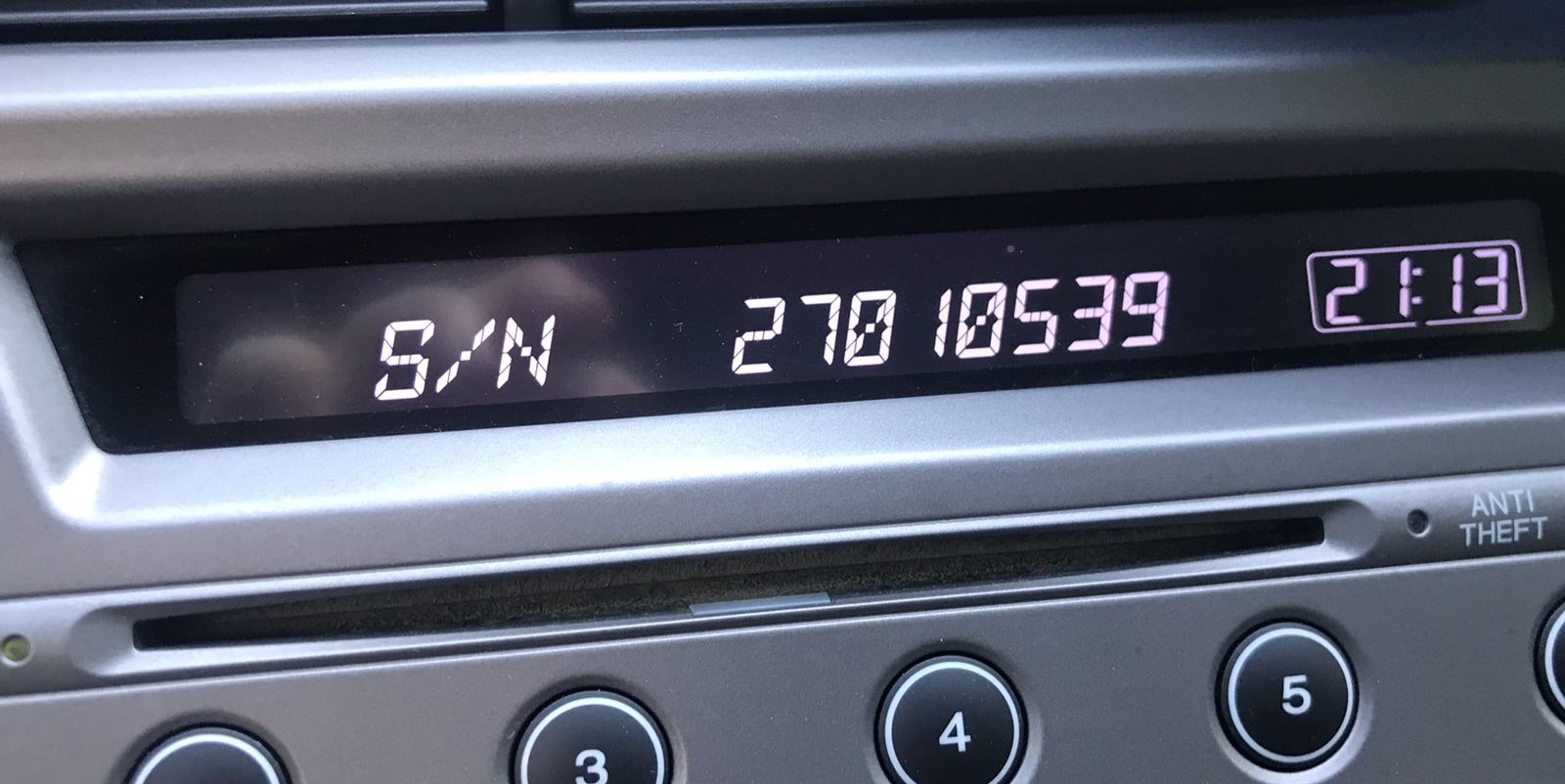
Example: Honda Civic serial number label location
S/N Patterns and Prefixes
The 2000 Honda Civic radio serial number follows the standard Honda OEM format:
U1234L5678– The standard Honda factory format – two halves displayed separately (U####thenL####), combined into a 10-character serial
The radio in the 2000 Civic is a standard-size CD player manufactured by Alpine or Panasonic under Honda's OEM contract.
Important The serial is 10 characters (U + 4 digits + L + 4 digits). Don't confuse it with the part number (usually starts with 39100, 39101, etc.).
Common Serial Number Formats on 2000 Civic Head Units
Factory Honda Civic head units from this era carry a printed serial number on the chassis label rather than a moulded-in code. Owners and unlock services most often report a short alphanumeric string with a single letter prefix.
For 2000 Civic factory radios, the serial number is typically an alphanumeric string of around 8 characters printed next to the barcode on the chassis label. Common Honda audio prefixes seen on Civic units include U (often reported on Alpine-supplied Civic radios) and M, with the rest of the string made up of digits and letters. The label also lists a Honda part number such as 39100-S04-.. - this is not the serial and should not be entered into a code lookup tool.
When copying the serial, take the longest alphanumeric string next to the barcode and double-check ambiguous characters such as O vs 0 and I vs 1 by comparing the printed text with the barcode. If the string you read does not match the patterns above, confirm that you copied the serial line and not the Honda part number, which sits separately on the same label.
Why Is the Radio Asking for a Code?
Honda's older radios include a built-in anti-theft system that engages whenever the radio is cut off from its battery connection. Typical causes include:
- Battery replacement — by far the most frequent cause; disconnecting the battery resets the radio's memory.
- Dead battery — an exhausted battery also triggers the lock as a disconnected one.
- Electrical repair work — service work that requires disconnecting power will activate the lock.
This security feature was built to discourage theft by making the radio inoperable after removal. As soon as you enter the correct code, the radio stays unlocked until the next battery disconnect.
Understanding Unlock Issues with Your Civic
When the radio comes on but does not display the "CODE" prompt, a few things could be happening:
- It's possible the anti-theft hasn't triggered — attempt using it directly first.
- Certain Honda radios show "CODE E" instead of simply "CODE" — this also means the same thing and code entry proceeds identically.
- It could be in an error state from a previous lockout — leave ignition ON for one hour, then look again.
Should the display stays blank, verify that the radio has a fuse — the ignition radio fuse may have failed during the battery disconnect that triggered the code request.
On older Honda single-DIN radios, code entry uses the 6 preset buttons along the bottom of the faceplate:
- Buttons 1 through 5 — use each to enter one digit of the five-digit code. Pressing it multiple times cycles through digits 0–9.
- Button 6 — hold this for 2–3 seconds to confirm the entered code.
A handful of early Honda models use a slightly different layout where buttons are labeled 1–4 plus SCAN and RPT — in that case, use SCAN or RPT to confirm instead of button 6. Consult your owner's manual if unsure which button confirms.
A frequent reason a code is rejected is entering a code generated from the wrong serial number. On older Honda radios, the label on the back of the unit carries two items: the serial number (e.g., U1234L5678) and the part number (e.g., 39100-SCV-...). Make sure you submitted the serial, not the part number.
Additionally verify that you copied the full 10-character serial correctly — the letter O and the digit zero look almost identical on these older labels. Contact support for a no-charge recheck if the code was rejected.
The serial number and the part number sit on the identical label on the unit chassis. It's a common mistake:
- Serial number: typically starts with
Ufollowed by digits, thenLand more digits — for exampleU1234L5678. This is what you need. - Part number: begins with
39100or39101— do not use this as the serial.
If the label is damaged, use the 1+6 preset button method to retrieve the serial on the radio screen instead. See the serial display section above for step-by-step guidance.
When the radio displays a lockout state after 3 wrong entries, keep the ignition turned ON and stay for one full hour. Don't turn the key to ACC or OFF during this period — doing so restarts the timer from zero.
Once the hour has passed, the radio should exit the lockout and show "CODE" again. At that point you can re-enter the correct code. Should the display show "ERR" or remains locked after waiting, contact support — some older Honda units require a dealer reset in extreme cases.